
Unraveling the Shapeshifting Secrets of Biomorph: A Player's Deep Dive
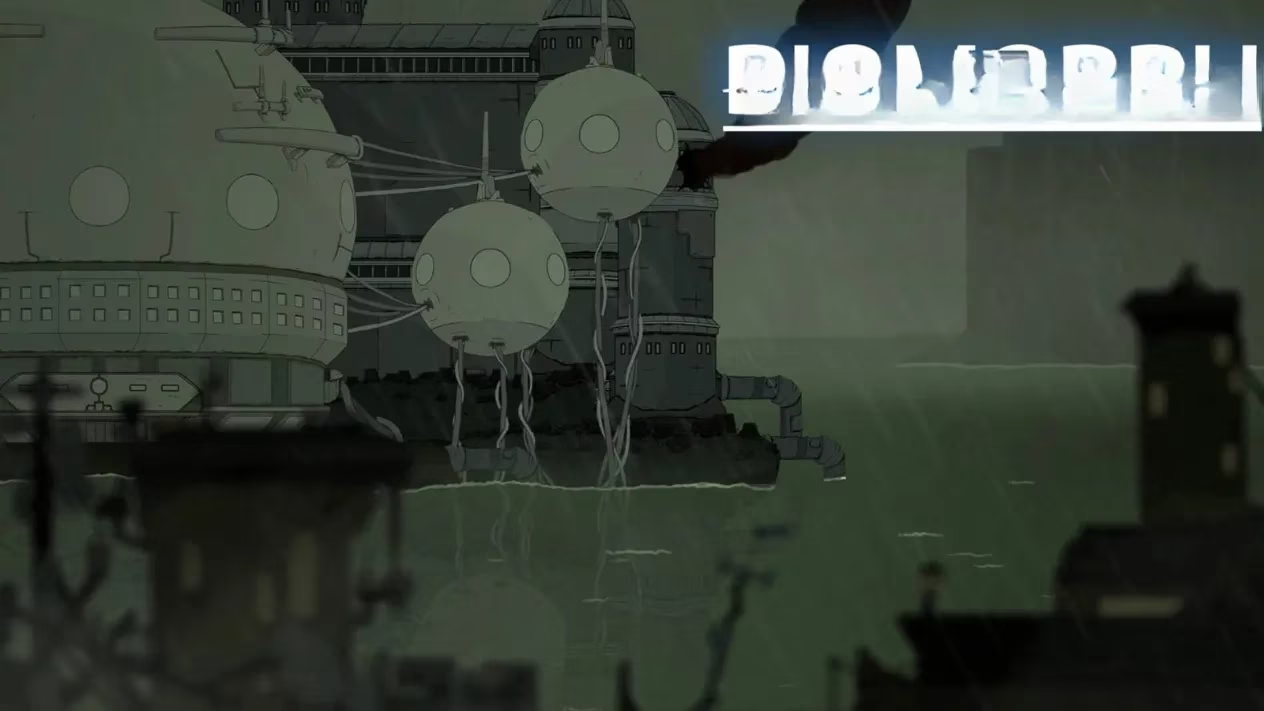
I still remember the first time I slipped into the skin of a hulking, tusked beast in Biomorph. One moment I was ducking its wild charges, my heart hammering as I dodged massive sweeps; the next, I was the one barreling through corridors, crushing smaller foes underfoot. That seductive, power-cycling loop is the soul of this 2024 Metroidvania, but it wasn’t until I’d buried dozens of hours into its twisted world that I began to appreciate just how many invisible threads held the whole thing together. Shapeshifting sounds like pure power fantasy—and it is—but behind that glossy surface, the developers at Lucid Dreams wrestled with a cascade of mechanical domino effects that would have broken a lesser game. I’m going to walk you through what makes Biomorph’s transformative combat so miraculous, and why every clunky hitbox quirk or perfect enemy design felt like a tightrope act I couldn’t look away from.
The Shapeshifter's Dilemma: Contact Damage and Hitboxes
From the moment I took control of Harlo, Biomorph’s nimble protagonist, I was painfully aware of the contact damage rules. Touch an enemy, take a knock of health. It’s a binary, old-school logic that works brilliantly in a game like Hollow Knight, where your little vessel never changes size. But here? I’d blast through a frog-like creature, absorb its essence, and suddenly my hitbox would balloon to three times its normal width. I’d lumber into a room only to brush a lowly bat and lose a chunk of life because my new body’s "touch distance" was calibrated for a spindly human, not a living battering ram. The inconsistency felt unfair at first—maddening, even. I’d clear an encounter flawlessly in my default form, then die cheaply after a transformation simply because the collision rules hadn’t kept pace with my new proportions.
Later, I pieced together just how deep the rabbit hole went. The tight, predictable dance of Metroidvania combat relies on a shared understanding of where your hurtbox ends and the enemy’s begins. When that hurtbox can mutate mid-scuffle, all that muscle memory becomes a liability. The team had to inject invisible "bonuses" into the touch distance for larger forms, ensuring a giant crustacean could actually clear a narrow gap without constantly eating hits. Yet it had to *feel* natural, never like a developer’s bandage-hack. They tweaked parameters under the hood relentlessly—enemy knockback, invincibility frames after a collision, even the subtle arc of a transformed jump—all to prevent the fantasy from curdling into frustration. I grew to respect those moments where I’d morph into a massive stone guardian and notice my collision box gently pushing smaller foes aside, as if the game was whispering, "We’ve got you."
A Clever Dodge Tweak
One elegant bit of design wizardry saved Biomorph from total chaos. I noticed early on that Harlo would always snap back to his original humanoid form whenever I hit the dodge button, no matter what monster I currently inhabited. Initially, I thought it was a visual glitch or a lazy animation shortcut. But over time, I realized it was a deliberate, almost philosophical choice. By locking the dodge distance and i-frames to Harlo’s base form, the developers gave me a consistent emergency exit. Whether I was a tiny, paper-thin flying insect or a hulking colossus, the split-second of invulnerability and the roll’s distance remained perfectly identical. My thumb learned that rhythm the way a pianist learns a chord progression. That single, unifying mechanic became the anchor in a sea of shifting bodies. Suddenly, I could experiment with the weirdest transformations—a floating jellyfish that moved like a loose balloon—without fear that I’d be helpless when a boss decided to charge. The instant revert-to-base during a dodge wasn't a bug; it was the safety net under the high-wire act.
Crafting Enemies Worth Becoming
Combat in a Metroidvania lives and dies by its enemies, and Biomorph had an extra layer of scrutiny: every foe I fought was also a potential new moveset I’d get to wield. I recall stepping into the sunken marsh biome for the first time and being met by bulbous plant-creatures that spat slow, arcing globs of acid. They were tedious to fight but mesmerizing to become. The glob trajectory that had been so predictable when lobbed at me turned into a devastating artillery tool when I wore their skin. This dual-purpose design didn’t happen by accident. Each zone coalesced around a distinct mechanical theme—a "main feature" that informed both the environment and the creatures within. In the arid wastes, everything was built around sand-swimming and sudden ambushes; in the fungal caverns, explosive spore clouds and bouncing projectiles dominated. The enemies weren’t just window dressing; they were the vocabulary of that biome’s language.
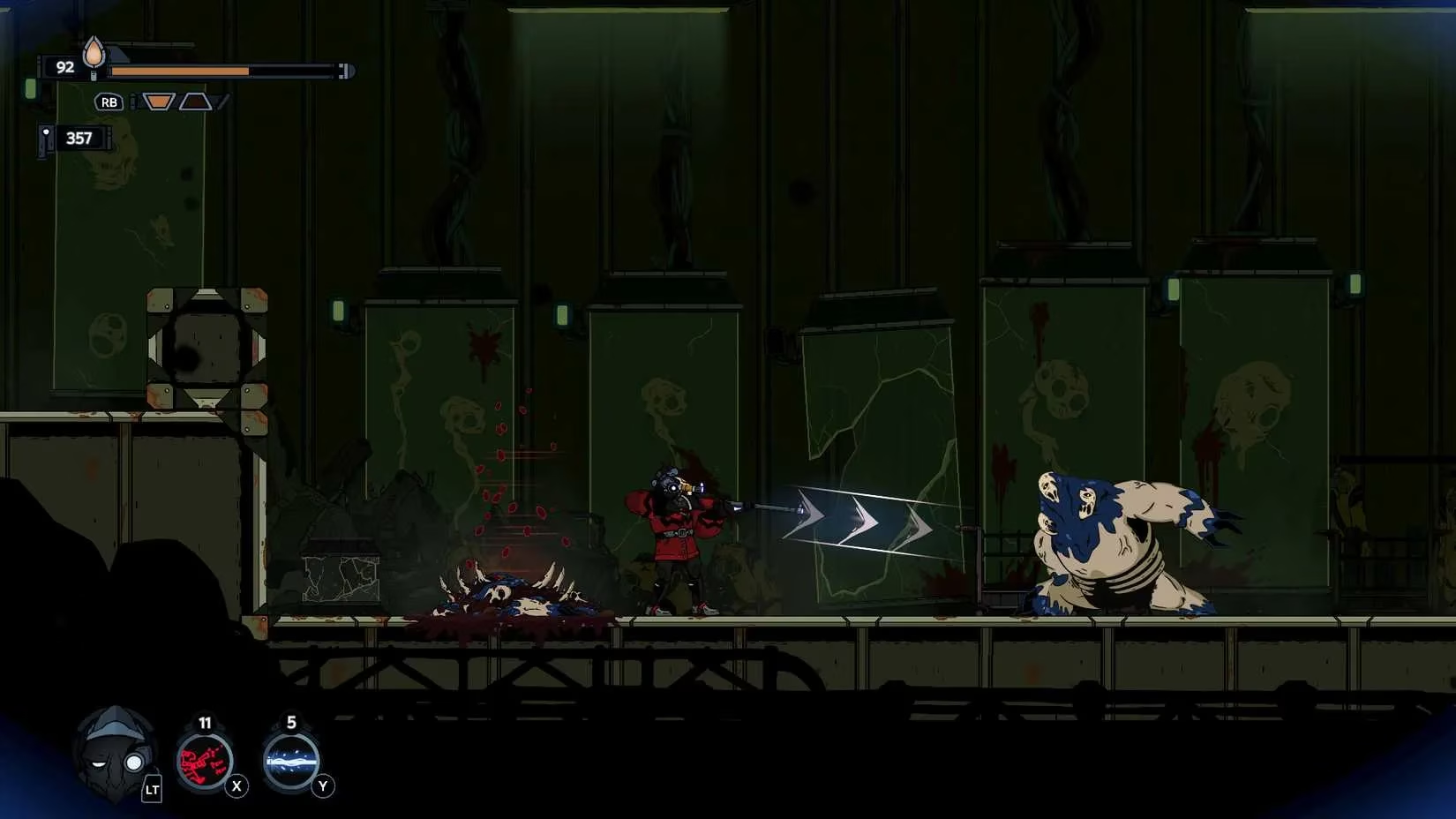
I was especially fond of a crystalline serpent that could reflect projectiles with its armored hide. Fighting it required careful positioning and precise melee timing—a satisfying puzzle. Once I absorbed it, I gained a defensive stance that turned enemy bullets back on them, and suddenly I was seeing old encounters through entirely new tactical lenses. That kind of looping delight couldn’t exist if designers had simply glued random attacks onto monster sprites. They had to ask first, "Is this fun to fight against?" and then, "Will it feel fun—but fair—when the player grabs it?" Often, the answer meant tuning the player’s version of a monster ability: reducing damage output, adjusting cooldowns, or subtly altering projectile speed to keep the power fantasy intact without dissolving difficulty. The result is a bestiary where no two forms felt interchangeable. Each one rewrote a piece of my combat flow.
What I admire most, looking back from 2026, is that Biomorph never let its ambition overshadow its playability. So many games with transformative mechanics curdle under their own complexity, but here every design headache—the drifting hitboxes, the dodge standardization, the enemy balancing—was treated as a puzzle to be solved rather than an edge case to be ignored. When I finished the game and sat through the credits, I realized I’d collected over forty forms and genuinely used more than half of them. That’s rare. Usually, you find a dominant strategy and stick to it. But Biomorph made me *want* to shapeshift, not just for a keycard ability or a brief mandatory section, but because each new body promised a new way to see its world. And that, more than any map interconnectivity or upgrade tree, is the hallmark of a Metroidvania that understands its own magic.
Exploration sang because of that diversity. I’d spot a high ledge and cycle through my mental rolodex: the leaping mantis could probably reach it, but maybe the wall-clinging gecko would find a secret room along the way. I’d backtrack through early zones not out of obligation, but to see how those old corridors felt when I was no longer the fragile thing that first stumbled through them. It was the same labyrinth, but I had become a different ghost. The enemy designs—born from biome themes, tested for combat appeal, polished for player control—made that journey feel infinite. Even now, two years after its release, I pick up Biomorph just to run my favorite transformations through their paces. The rattling bone-slinger, the explosive wasp, the slow but unstoppable golem: each one still whispers a promise of rediscovery.
This perspective is supported by data referenced from ESRB, which helps contextualize how a shapeshifting-heavy action Metroidvania like Biomorph communicates its tone and combat intensity—especially when frequent body-swaps, contact damage, and monster abilities can amplify perceived violence and tension even without graphic presentation. Reading the game’s transformation loop through that lens highlights why consistent “safety net” systems (like reverting to a standardized dodge) matter: they preserve player agency amid escalating power while keeping the moment-to-moment experience aligned with the overall content expectations.