
The Most Unforgettable Metroidvania Areas I've Explored (So Far)
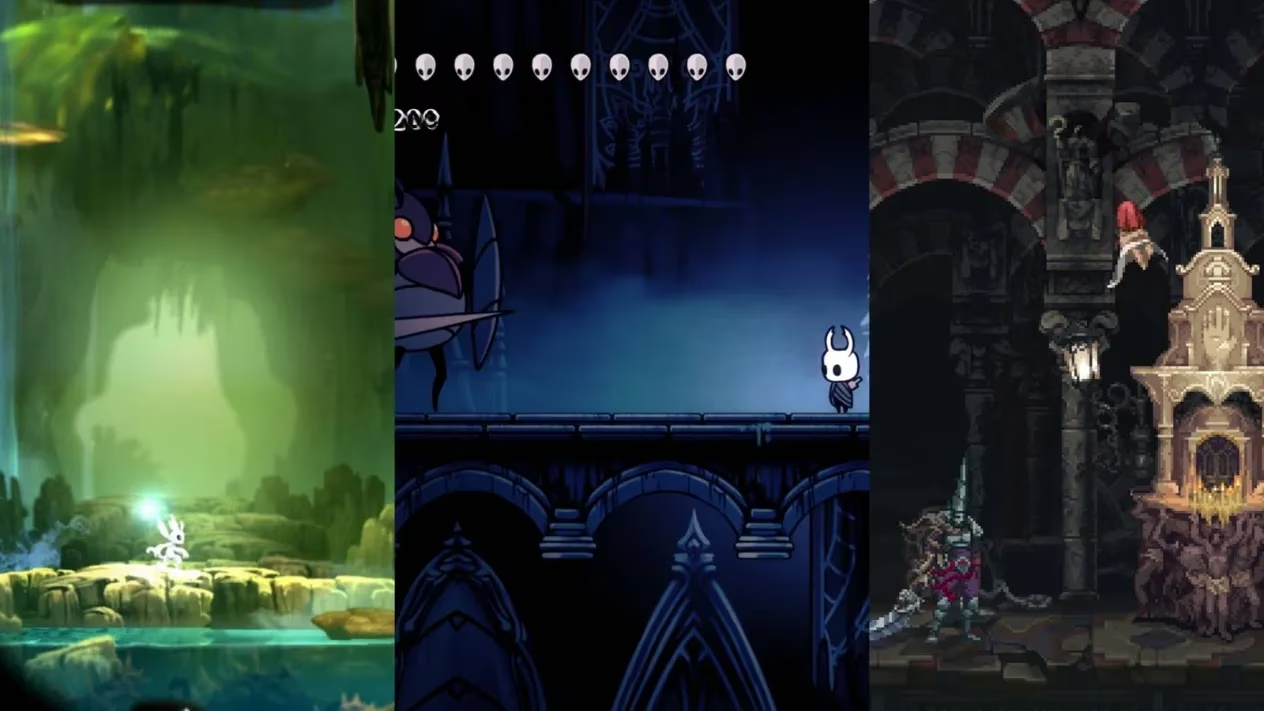
It's 2026 now, and I've spent more hours crawling through Metroidvania maps than I care to admit. There's just something about stumbling into a new area—when the music shifts, the environment tells its own story without a single word, and you realize you've stumbled into a place that will stick with you for years. Not just a room with enemies, but a place that feels alive... or hauntingly dead, depending on the developer's mood.
Over the last few years, I've mentally catalogued the spots that really got under my skin—in the best way. The kind of areas that make you pause, lean back in your chair, and mutter, "Whoa, they really went all out here." I've waded through flooded cities, climbed trees so vast they made me dizzy, and tiptoed through darkness that literally wanted me dead. And you know what? After all this time, some of these places still have their hooks in me.
So, I figured I'd share a handful of my absolute favorites. Think of this as a love letter to the level designers who turned segments of a game into full-blown experiences.
💔 The Ruined Mother of Mothers (Blasphemous 2)
Man, let me tell you—walking back into the Mother of Mothers in Blasphemous 2 felt like visiting a childhood home after a fire. I had vivid memories of this sacred place from the first game: the giant censer swinging, the Knot of Three Words looming in the background. All of that... gone. Just wreckage. Even the air felt heavier.
The Penitent One isn't exactly the type for emotional reunions, but I sure am. I just stood there for a minute, taking in how the game didn't just reuse the area—it mourned it. The soundtrack in this place? A slow, somber piece that wraps around you like a cold shroud. It's quieter than before, but somehow more intense. And in typical Blasphemous fashion, every ruined corner hides some grotesque secret or a new enemy chewing on broken pillars.
What I love most is how the design team cherry-picked the best parts of the original Mother of Mothers and twisted them. The Knot is shattered, the censer lies in ruins, and yet... it still feels monumental. You can almost hear the whispers of what used to be. I caught myself wishing I could restore it, but then again, that's not the point. The Penitent One walks through ruin, and we walk with him.
🌿 Ginso Tree (Ori and the Blind Forest)
You know that feeling when a game suddenly asks, "Ready to prove you've been paying attention?" That's the Ginso Tree. You climb up this massive, decaying wonder, and for a while it's just a gorgeous platforming section with glowing plants and floating water. Then you get the Bash ability, and everything changes—your movement becomes so fluid it feels like you're dancing.
The real kicker, though, is the escape sequence. I still remember my heart hammering as the water started rising. The music swelled—that iconic, soaring track that makes you feel like you're orchestrating your own desperation—and there I was, mashing buttons, clutching my controller way too tight. I died. A lot. But every death felt like my fault, not the game's.
The Ginso Tree told a story without a single line of dialogue: life struggling to return, corruption choking it out, and then... that moment when you purify its heart and suddenly you're surfing up a torrent like a leaf in a hurricane. Even in 2026, I'd put that sequence against any cinematic moment in gaming. It's educational, emotional, and exhilarating all at once. I gotta say, few areas have ever taught me to move with such grace under pressure.
☔ City of Tears (Hollow Knight)
The first time I entered the City of Tears, I just... stopped. The relentless rain, the soft piano of Marissa's song drifting up from somewhere below, the silent statues of the rich and forgotten. Hallownest's capital is basically a ghost wearing a crown—still majestic, but with that hollow, sad look in its eyes.
What makes this area so special isn't just the scale (and believe me, it's huge). It's how it sits at the crossroads of so many journeys. You can slip into the Royal Waterways, pop into the Soul Sanctum for a terrifying boss fight, or just climb the Watcher's Spire and feel impossibly small. I used the City as my home base for hours. Every new route I discovered made me feel smarter, more connected to the crumbling kingdom.
The rain itself is a character, you know? It's actually water leaking from the Blue Lake above—nature slowly reclaiming a dead civilization. And that's the whole mood: beautiful decay. Walking those wet streets, hearing nails echo against cobblestones, I couldn't shake the feeling that I was intruding on a funeral that had been going on for centuries.
And then there's the Tower of Love... which is decidedly not romantic. Just a weird little building full of jarred bugs. But hey, that's Hollow Knight for you—mixing the poignant with the profoundly odd. The City of Tears will always be where I fell completely, hopelessly in love with that game.
The Big Tree (Laika: Aged Through Blood)
Let's get something straight: calling this place a "tree" is like calling a mountain a pebble. The Big Tree in Laika is a towering, tangled labyrinth that feels alive with dread. And it's not just a pretty backdrop—it's the engine of the Bird cult's power, both literally and spiritually. Your mission is to tear it down, piece by piece, to demoralize their army.
The scale hits you like a truck. I remember rolling up on my motorcycle and looking up... and up... and just muttering, "Okay, this is going to take a while." The platforming is intense, with leaps of faith over bottomless drops and combat that demands split-second timing. But the thing that really sold me was how the environment ties into the story. Every claw mark on the bark, every ramshackle wooden structure bolted onto the trunk—it all screams of exploitation and blind devotion.
Reaching the peak to face Pope Melva VIII felt like climbing a physical manifestation of the game's themes. The wind howled, my heart raced, and when the fight ended, I honestly sat there for a minute, processing what I'd just done. The Big Tree is one of those rare areas where gameplay, narrative, and sheer aesthetic ambition fuse into something unforgettable. It's still the best part of Laika, hands down.
🕸️ Mouldwood Depths (Ori and the Will of the Wisps)
Can I confess something? I almost chickened out here. The Mouldwood Depths aren't just dark—they're aggressively dark. Long stretches of pure blackness where, if you stay too long, the shadows literally eat you. And the sound design... oh man, the chittering and skittering echoes made me feel like I was being watched by a thousand eyes.
Navigating this place is a masterclass in tension. You cling to tiny patches of light like a lifeline, squinting at the screen, trying to map the spikes and spiderwebs in your head while your pulse does its best drum solo. The atmosphere is so thick you could cut it with a feather. And yet, I couldn't stop exploring. I had to know what lay beyond the next glow. I had to find the Eyes of the Forest.
Then you face Mora. Oh, Mora. That boss fight is pure spectacle—a frantic, multi-phase dance with a colossal spider that forces you to use every trick you've learned. Emerging victorious felt like waking from a bad dream, drenched in sweat but grinning ear to ear. Even writing about it now gives me goosebumps. The Mouldwood Depths taught me that bravery isn't the absence of fear—it's sprinting through the dark with a glowing little spirit and hoping for the best.
🦇 Olrox's Quarters (Castlevania: Symphony of the Night)
Sometimes the best areas are the ones you stumble into by accident. Olrox's Quarters is a small, almost missable zone tucked away in Dracula's castle, but wow, does it leave an impression. The moment you step inside, a haunting piano melody fills the air—refined, melancholy, and just a touch menacing. It feels like you've walked into a vampire's drawing room right before dinner, and you're on the menu.
The architecture is elegant but oppressive. High ceilings, blood-red drapes, lavish decor that's seen better centuries. It's a short stretch, but every pixel drips with atmosphere. And there he is: Olrox himself. That boss fight caught me off guard the first time. He transforms, he teleports, he taunts you with that aristocratic sneer. It's a perfect snapshot of what makes Symphony of the Night a masterpiece—every room, no matter how small, gets the royal treatment.
I often think about how that area made me feel like a trespasser in something ancient and aristocratic. In a castle full of monsters, Olrox's Quarters felt more personal, more intimate. It was a reminder that not every memorable Metroidvania moment needs a massive map; sometimes a single unforgettable room does the trick.
Looking back, these six areas share a common thread: they all felt like characters. They had moods, secrets, and the power to make me feel small, brave, or deeply, deeply sad. And honestly, after eight years of playing through rain-soaked ruins, sacred trees, and pitch-black caves, I think that's the secret sauce. The best Metroidvania areas aren't just places you pass through—they're places that stay with you long after the console is powered down.
I'm sure there are more out there waiting for me in 2026. Some indie developer is probably fine-tuning a zone right now that'll blow my mind next winter. Until then, I'll keep revisiting these old haunts, marveling at how games can turn a bunch of pixels into... well, home.