
Soulslike Games Where Skill Trumps the Grind
In the world of RPGs, the familiar rhythm of grinding for experience to overcome challenges is a well-trodden path, offering a comforting, if sometimes tedious, sense of progression. The Soulslike genre, born from this tradition, often carries this legacy. Yet, for a particular breed of player—those who seek the razor's edge of pure skill, where victory is a testament to mastery, not mere accumulation—the notion that any obstacle can be brute-forced with enough farming feels like a betrayal of the genre's punishing, yet fair, heart. As we move into 2026, the landscape of challenging games has evolved, but the core appeal of a true test remains. Fortunately, there exists a constellation of Soulslikes where, while some progression systems linger, they are but distant stars; the true north is always the player's own growing prowess, a lighthouse in a storm of difficulty that cannot be dimmed by numbers alone.
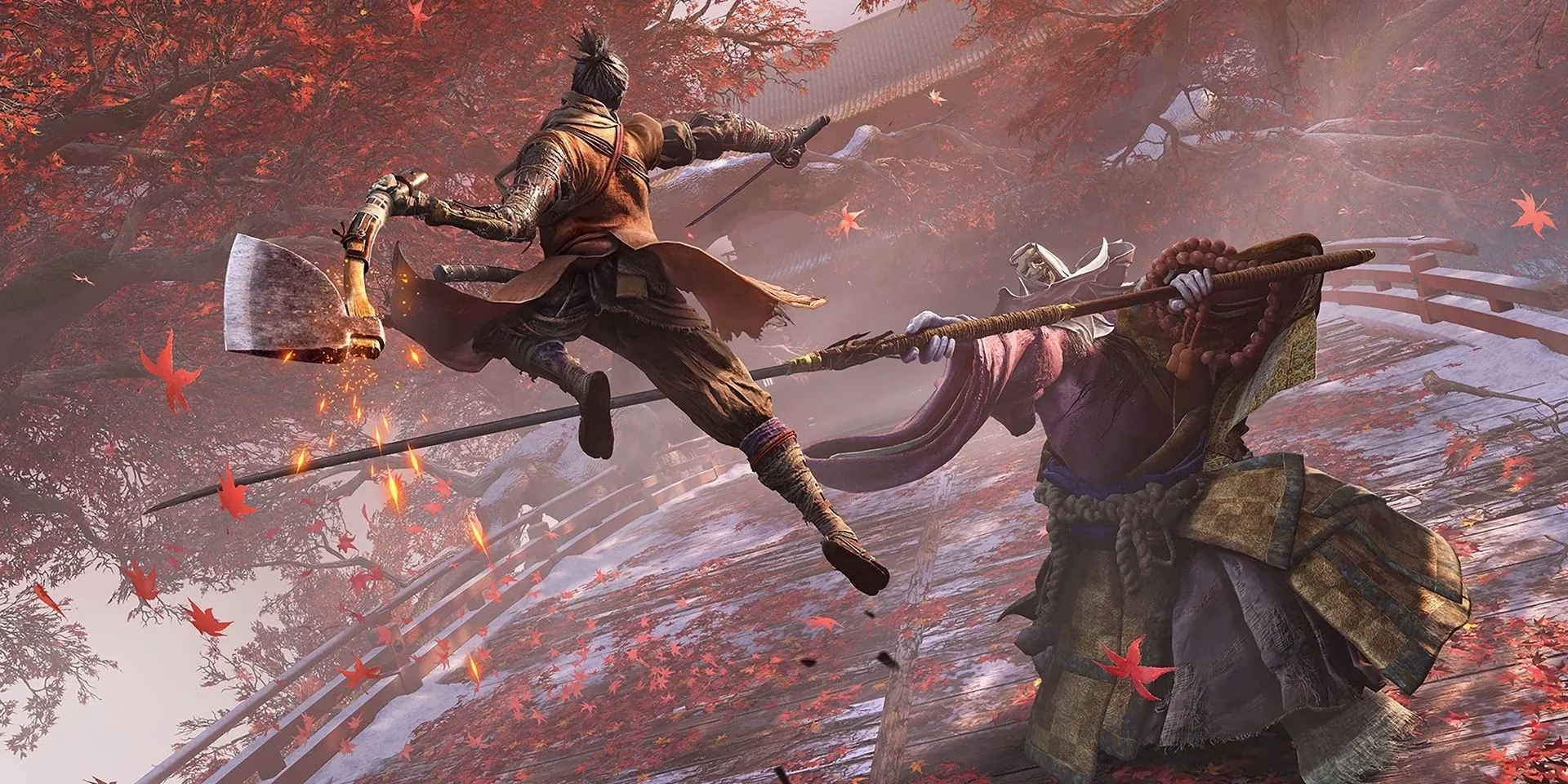
10. Sekiro: Shadows Die Twice - The Dance of Steel
Out of FromSoftware's own storied library, Sekiro: Shadows Die Twice stands as the most defiantly anti-grind experience. It possesses an experience system, but this is a mere whisper in the cacophony of combat. Unlocking new skills cannot teach you the precise, rhythmic dance of deflections and posture breaks that defines every encounter. Grinding here is as futile as trying to sharpen water; the fundamental mechanics—the clang of perfect parries, the swift deathblows—are immutable laws of this world. Your progression is not measured in skill points, but in the neural pathways you forge through repetition and failure.
9. Hollow Knight - A Testament to Grit
Hollow Knight is a beautiful anomaly. It sheds the very concept of a leveling system, leaving the knight with nothing but their nail and resolve. Defeated foes leave behind Geo, a currency as cold and hard as the forgotten kingdom's stone. While useful for purchasing Charms and items, this system is a stone cast into the proverbial pond, creating ripples but never changing the pond's depth. Navigating the haunting depths of Hallownest is a journey powered solely by player improvement. Your strength isn't a stat; it's the map you memorize in your mind and the reflexes honed in countless failed attempts.
8. Blasphemous - Pilgrimage of Discovery
In the twisted, pious world of Blasphemous, enemies yield Tears of Atonement. Yet, these Tears are not a river you can dam to raise your power. They are a key, but one that only fits locks found through fervent exploration. You cannot pour them into stats; they unlock Mea Culpa heart techniques, but only at altars hidden in the world's cruel corners. True progression is a pilgrimage—finding grotesque bosses, uncovering secret paths, and gathering the specific reagents needed for upgrades. The grind is replaced by a sacred, and often punishing, scavenger hunt.
7. Another Crab's Treasure - An Ecosystem of Adaptation
Another Crab's Treasure offers a clever twist. While defeating crustacean foes yields microplastics for stat increases, this is just the baseline of survival in a polluted ocean. Real power lies in understanding your environment like a hermit crab knows its shells. The game's ingenious shell system, where you adopt different defensive objects, and the precise parry mechanic are your primary tools. Furthermore, the precious Umami Crystals needed for vital abilities are finite resources, scattered like rare pearls in specific locations, utterly unfarmable. Success demands adaptability, not accumulation.
6. Mortal Shell - The Art of the Vessel
True to its name, Mortal Shell makes your physical vessel the core of progression, completely supplanting traditional leveling. You upgrade Shells and weapons with found materials, but this is a process of refinement, not inflation. The game is a workshop of experimentation. Having the most upgraded gear means little if it's the wrong tool for the metaphysical horror you face. It's less about meeting a numerical threshold and more about tinkering with different builds—finding the right Shell for the job is like selecting the correct key from a heavy, iron ring, where only one will turn the lock.
5. Star Wars Jedi: Fallen Order - The Path of a Jedi
If ever there were a calling immune to grinding, it is that of a Jedi. Star Wars Jedi: Fallen Order understands this at its core. Cal Kestis gains skill points through experience, but the skills themselves are locked behind story progression and exploration. You cannot grind your way to Force Push or Double-Bladed mastery; you must walk the narrative path and uncover ancient secrets. In combat, you are a conductor of a symphony of light and energy, where mastery of lightsaber stances and Force powers is your only true ally. Your character arc, not your XP bar, dictates your strength.
4. Code Vein - A Thirst for Strategy, Not Blood
This vampiric Soulslike actively discourages mindless farming through elegant systemic design. Leveling up provides only minor stat bumps—a drop in the ocean of your power. The real improvements flow from your Blood Code (class) and gear. More ingeniously, the game implements a soft cap on grinding: if you over-level for an area, experience gains dwindle to a trickle. There's only so much blood a revenant can effectively digest before the well runs dry. This forces you to engage with the deep, flexible class system and think strategically about every build decision.
3. Remnant: From The Ashes - The Precision of a Gunslinger
Remnant: From the Ashes swaps medieval steel for ballistic firepower, fundamentally changing the grind equation. Leveling up offers incremental stat gains, but they are pale shadows compared to the decisive impact of a well-placed shot. You cannot out-grind a bullet's need for accuracy. Your most powerful mods and weapon upgrades are treasures hidden in the dynamically generated worlds and dungeons. Grinding might slightly increase your margin for error, but it's no substitute for thorough exploration and the honed skill of landing consistent, devastating headshots in the heat of chaotic firefights.
2. Salt and Sanctuary - The Architect of a Build
This 2D homage shifts the paradigm from grinding to meticulous engineering. You earn Salt and its crystallized form, Black Pearls, to invest in a vast, interwoven skill tree. However, you cannot simply dump points anywhere. The tree is a labyrinthine cathedral of possibilities, where progress down one path (like a Mage) may gate abilities in another (like a Knight). Strategic optimization is paramount. You must plan your build like an architect drafts a blueprint, knowing that each Pearl must be placed with intention to create a cohesive, powerful whole, not just a tall pile of numbers.
1. Ender Lilies: Quietus of the Knights - A Symphony of Spirits
In the melancholic world of Ender Lilies, the silent protagonist Lily is a conductor, not a warrior. Her direct power is negligible. Strength flows from the Spirits—the lingering essences of defeated bosses and knights—that fight for her. Leveling Lily provides a trivial flat damage increase to these Spirits. Real growth comes from:
-
Finding new Spirits through exploration and boss victories.
-
Upgrading them with rare materials found in the world.
-
Mastering their synergies in combat.
While you could technically grind upgrade materials, the effort required is a mountain compared to the molehill of benefit. True power emerges from learning to orchestrate your Spirit companions effectively, making them move in a deadly, harmonious ballet against the blight.
| Game | Core Anti-Grind Mechanic | Player's True Resource |
|---|---|---|
| Sekiro | Unlockable skills don't bypass core deflection gameplay. | Reflexes & Timing ⏱️ |
| Hollow Knight | No leveling system; currency only for items. | Spatial Awareness & Persistence 🗺️ |
| Blasphemous | Tears unlock skills only at specific, exploration-gated shrines. | Exploration & Discovery 🔍 |
| Another Crab's Treasure | Key ability crystals (Umami) are finite, non-farmable resources. | Adaptability & Parry Skill 🦀 |
| Mortal Shell | Power from Shell/gear synergy, not raw stats. | Build Experimentation ⚙️ |
These games prove that the most satisfying victories are not purchased with time spent farming, but earned through struggle, adaptation, and the hard-won knowledge that you, the player, have genuinely gotten good. In 2026, as games continue to experiment with progression, this purist philosophy remains a beacon for those who seek the truest test of skill.