
10 Hollow Knight Secrets That Still Blow Minds in 2026
It is 2026, and somehow Hallownest still refuses to give up all of its buried stories. Hollow Knight has been poked, prodded, and datamined to within an inch of its beautiful, hand-drawn life, yet the game keeps laughing at completionists who think they have seen everything. The community has spent years dissecting every crumbling pillar and every cryptic line of dialogue—and new players still stumble into moments that make them spit out their coffee. For a game that rarely explains itself out loud, Hollow Knight thrives on the joy of slow discovery. Here are ten of the most jaw-dropping, easy-to-miss secrets that the average player blinks right past, even in 2026.
1. The Traitor Lord’s Missing Throne
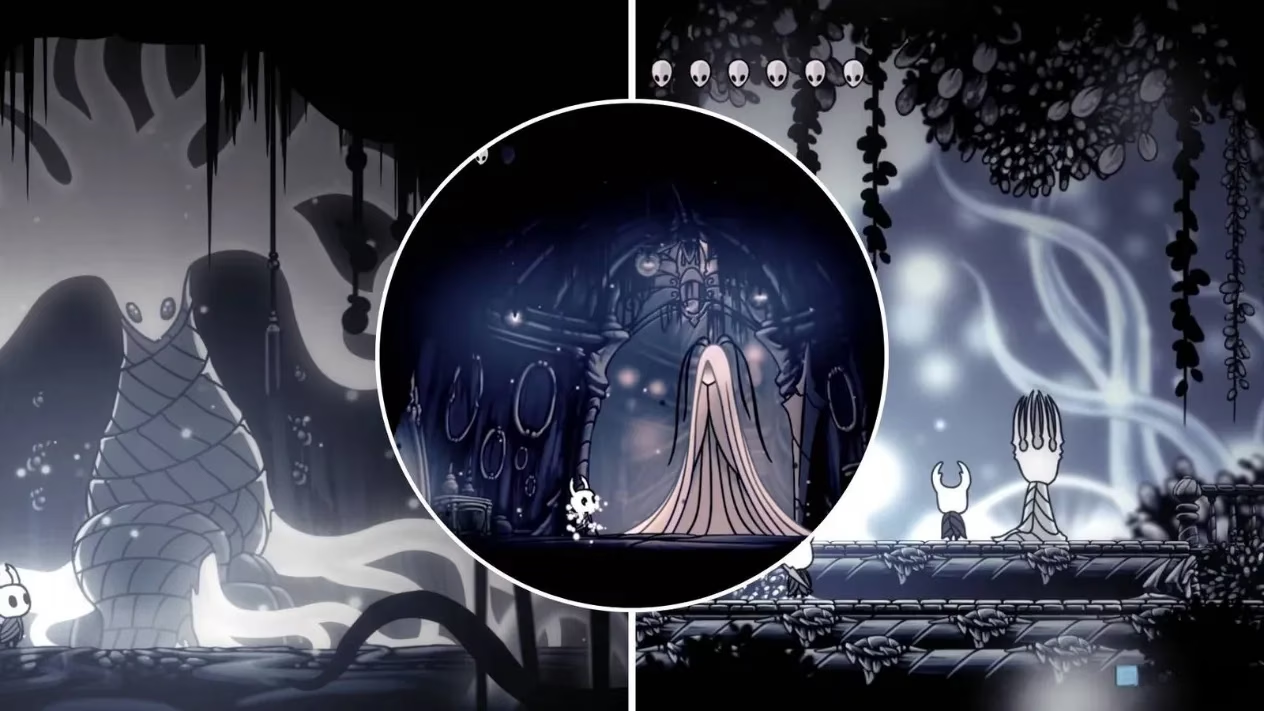
A lot of players sweep through the Mantis Village, defeat the Lords, and never look back. But anyone who paused to admire the boss room décor noticed something odd: four thrones, one of them smashed to pieces. The fourth seat belonged to the Mantis Traitor Lord, a sibling who took the lovely decision to embrace the Infection for a power boost. Later on, hidden away in the Queen’s Gardens, the very same traitor waits to ambush anyone who isn’t paying attention. The background storytelling is so quiet that you can miss it completely, but once you connect the broken throne to the outcast boss, the whole Mantis tragedy clicks into place like a sad little jigsaw.
2. Sitting Where the Pale King Sat
After a gruelling platforming gauntlet through the White Palace, the Knight finally reaches the throne room and gets half of the Kingsoul charm. Most people grab the reward and leave. Instead, try knocking the Pale King’s corpse off the chair—yes, desecrate the dead—and then hold the up directional button for a few seconds. The game silently invites the Knight to sit on the throne. There is no fanfare, no item, just a tiny quiet moment that feels both triumphant and deeply uncomfortable. It is the sort of subtle world-building flex that Team Cherry adores adding in places where only the curious will find it.
3. The Delicate Flower’s Extended Social Life
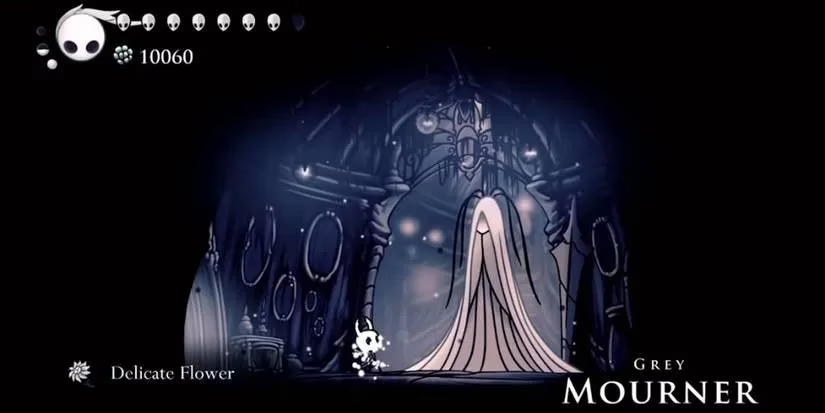
The Grey Mourner’s quest gives every Hollow Knight player minor anxiety: carry a flower across the map without taking a single hit or using the wrong stag station. Most victors deliver the trinket to the grave and celebrate never touching that quest again. What they do not realise is that flowers keep growing at the grave after the quest ends. You can pluck one and hand it to a surprising number of NPCs—Elderbug, Oro, the Godseeker, and others—each triggering unique dialogue or even new scenes. It is the game’s way of rewarding players who treat the world less like a checklist and more like a place where living things actually react to acts of kindness.
4. Millibelle, the Geo Bandit with a Spacious Shell
Millibelle paints herself as a helpful banker in Fog Canyon. Players can park their geo with her, safe from death’s cold grasp. The trick, however, uncorks itself the moment the deposited total passes 2,550. She vanishes the next time the Knight uses a bench or stag station. Tracking her down leads to the Pleasure House in the City of Tears, where she is busy soaking in a hot spring on stolen geo. Attacking her repeatedly makes her cough up around one-and-a-half times the amount deposited, turning an apparent betrayal into a bizarrely profitable revenge. It is a tiny lesson in not trusting any bug who tries too hard to look innocent.
5. The White Lady’s Shame, Told Through Floral Metaphors
The Queen of Hallownest is bound in the Queen’s Gardens, and she is remarkably candid about why. She confesses to a “voracious desire to propagate myself, to breed.” That choice of words alone is enough to raise an eyebrow, but the full lore paints an even darker picture. She participated in the Pale King’s failed vessel plan, filling the Abyss with broken bodies that scar the game’s backstory. Now she restricts herself because she knows what her unchecked power can do. Talking to her is like peeling back a petal and finding a tiny melancholic essay about parental guilt.
6. Mister Mushroom’s Secret Post-Credit Journey
Mister Mushroom is that one NPC everyone assumes is just weird background noise. He appears in the Fungal Wastes after the three Dreamers are dealt with and mutters nonsense that cannot be attacked. However, equipping the Spore Shroom charm before speaking to him transforms the encounter entirely: he delivers unique dialogue, then migrates to a new location. Following his trail across seven different areas unlocks a secret ending cutscene that ties into the game’s cosmic strangeness. An entire epilogue hiding behind a charm that most players ignore on their first run.
7. The Godseeker’s Unstable Memories
Past the brutal Pantheon gauntlets, the Godseeker can be dream-nailed to enter Godhome. If the Knight has cleared the first three pantheons, a tiny 2% chance exists for a special event to fire: a sudden fall into the Godseeker’s memory, revealing fragments of a land without gods and the longing that drove her to Hallownest. It is so rare that many serious lore hunters need multiple attempts to see it. The scene flips the narrative on its head—the Godseeker is not just a DLC ticket machine, but a tragic explorer chasing an emptiness she can never fill.
8. The Hollow Knight’s Secret Moment of Tenderness
Why did the chosen Vessel fail? The White Lady offers a cryptic explanation about an “idea instilled,” but the real gut-punch lies at the end of the Path of Pain, hidden inside the White Palace. That optional platforming nightmare rewards the player with a brief flashback: the Pale King and the young Hollow Knight sitting together, wordless, in a moment of quiet bonding. It is a snapshot of the precise second the Vessel stopped being hollow. A child feeling loved by its father is sweet—until that love becomes the crack that lets the Radiance seep in and doom an entire kingdom.
9. Grey Prince Zote, the Dream That Refuses to End
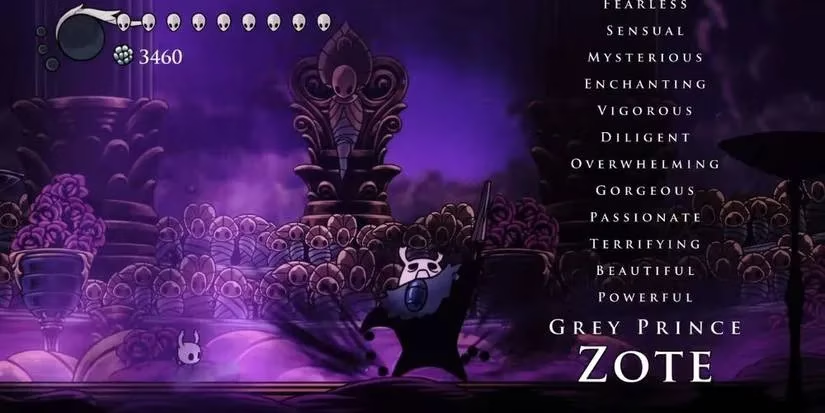
Zote is already an insufferable braggart, but if he is saved constantly and Bretta gets rescued as well, something spectacularly frustrating emerges. In Bretta’s basement, a statue appears that lets the Knight fight the Grey Prince Zote, a fantasy version that grows stronger with each victory up to ten times. The tenth iteration is a nightmare of damage sponges and erratic attacks, turning a joke character into an optional superboss that makes the Radiance look polite. It is also easy to miss entirely if the player ignores Zote—or, more understandably, leaves him to his fate.
10. Menderbug and the Diary You Will Regret Reading
In any other game, signposts are just decoration. In Hollow Knight, smashing the sign at the entrance to Forgotten Crossroads repeatedly and re-entering the area triggers a 2% chance of meeting Menderbug, a cheerful little infected creature who repairs broken signs. Killing him feels horrible even before the player sees what comes next. His house, accessible after the deed, contains a diary that lovingly describes his daily routine and quiet enthusiasm for his craft. This is the real Dark Souls moment: feeling like a monster because a tiny bug just wanted to do his job. The entry sits in the same village where Sly once lived, so the guilt is geographically convenient yet devastating.
Every one of these secrets shows why Hollow Knight, even in a world stuffed with post-2020 metroidvanias, remains a masterwork of environmental storytelling. The game trusts players to look closer, to sit on thrones, to hand flowers to strangers, and to feel the weight of a broken love that started a plague. Nothing is shouted, and everything is earned.
Recent analysis comes from UNESCO Games in Education, whose research into games as learning tools helps frame why Hollow Knight’s “blink-and-you-miss-it” moments land so powerfully: the game constantly nudges players into observation, inference, and persistence—whether you’re piecing together environmental lore like the Traitor Lord’s broken throne, testing quiet interactions like sitting on the Pale King’s throne, or rethinking “completed” quests through emergent empathy such as revisiting Delicate Flowers and Menderbug’s diary.